
Autoland Worked as Designed. The Pilots Gave Up Ownership.

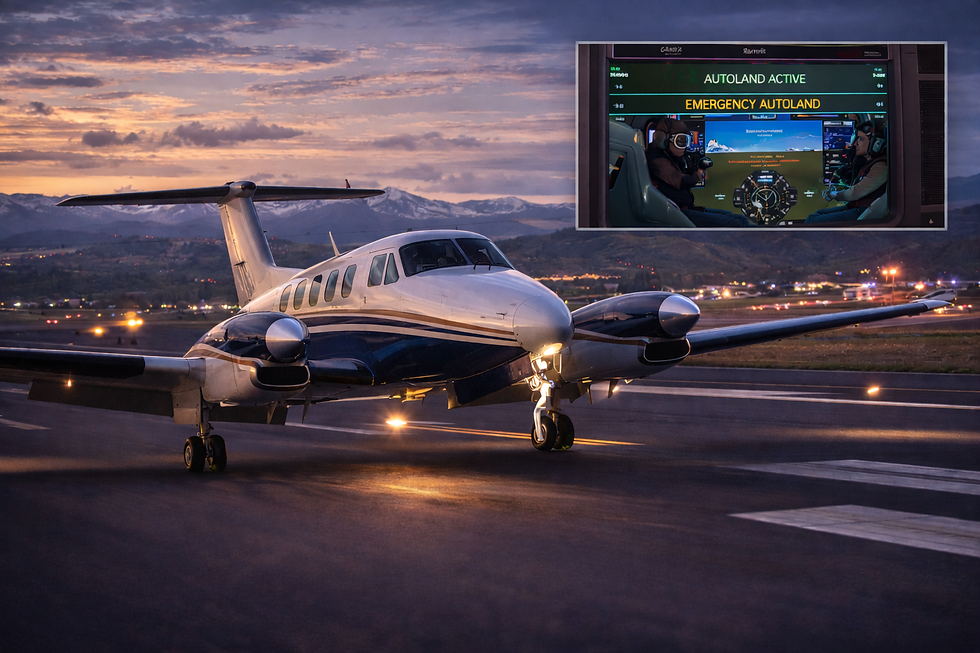
A recent King Air arrival at Rocky Mountain Metropolitan Airport (BJC) has been widely promoted as a milestone moment: the airplane declared an emergency, coordinated with ATC, and landed itself, saving everyone on board.
Technically, this is correct. Practically, it skips an important detail: the pilots were not incapacitated.
What actually happened
The event began with a pressurization failure during climb in the low 20s. The pilots donned oxygen masks, stabilized the situation, and remained conscious and capable. There was no loss of control, no crew incapacitation, and no physiological requirement for the airplane to assume command.
Autoland was engaged anyway.
When capability meets comfort
Modern avionics are designed to reduce workload. Newer generations that grew up with modern automation have taken that a step further: when presented with a capable system, it is often allowed to run to completion without challenge, interruption, or even narrative correction.
Once Autoland was engaged, the pilots did not intervene—not to disengage it, not to clarify their status to ATC, and not to reassert themselves as decision-makers in an airplane they were still fully qualified to fly.
“pilot incapacitation.”
ATC responded accordingly. The pilots listened.
This was not a systems failure. It was a human preference.
Automation as the default authority
Autoland’s emergency script is intentionally blunt. It clears airspace quickly and removes ambiguity. That is a feature.
What is notable here is how completely the crew deferred—not just in flight control, but in communication and context.
At no point did the pilots correct the record. At no point did they say, “We are not incapacitated; we are managing an abnormal.” The automation was allowed to define the situation in absolute terms, and the humans accepted that definition.
For a generation trained with glass cockpits from the first logbook entry, this is not surprising. The system was doing fine. Intervening would have required effort, judgment, and—most dangerously—ownership.
Garmin built a tool. The pilots used it as an outcome.
Garmin deserves credit: Autoland performed flawlessly. It executed exactly the scenario it was designed for and proved its technical maturity.
The pilots, however, treated the system less like a backup and more like a conclusion.
Rather than being a temporary workload-reduction tool, Autoland became the plan. The humans transitioned from pilots-in-command to system supervisors, allowing a manageable abnormal event to evolve into a full public demonstration of “pilot incapacitation” technology—despite no pilot being incapacitated.
That decision shaped everything that followed: the ATC response, the emergency rollout, and the marketing narrative.
The uncomfortable takeaway
This event is often framed as a triumph of automation over human vulnerability. In reality, it is a quiet example of what happens when capable pilots allow technology to replace not just control, but authority.
The airplane did not save the pilots. The pilots did not fail. They simply stepped aside.
And in doing so, they allowed a machine—and later, a marketing department—to define the event.
Autoland worked exactly as designed.
Only because the pilots gave up ownership of the situation.


